Scottish Genealogy

Showing posts with label family. Show all posts

Monday, 14 May 2012

Mystery Monday - Who's that man?

In one of the bundles of photographs at home we have this one of a young soldier, presumably from the First World War period:

one of the Macdonald boys (WWI)

My grandfather, Malcolm, had four brothers who served in the war, John, Alexander, Duncan, and Peter.  The family sadly lost three of these boys in the war and only Peter and my grandfather (the youngest) survived, along with their sister Mary.

We presume that this is one of the boys, but do not know which one - as far as we can gather the boys served as follows:

  • Peter Cameron Macdonald served as a private in the Argyll and Sutherland Highlanders, spending the war mostly in the Balkans and France
  • John Macdonald was a corporal in the Argyll and Sutherland Highlanders (A company, 2nd battalion) and previously in the 93rd Highlanders.  He died at Arras, 24 April 1917 aged 25
  • Alexander Macdonald was a sergeant in the Argyll and Sutherland Highlanders and in the Black Watch (8th battalion) - he died 19 July 1918, aged 23.
  • Duncan MacCrimmon Macdonald was a private in the Highland Light Infantry (1st/5th battalion) and died 24 August 1918, aged 21.
Now, the man in the above photograph seems to have at least one stripe on his arm, which makes me think that it should be John or Alexander as they are the ones who held a rank above private (as far as we know), but we just do not know which of them it could be.

There is another photograph that may hint at this definitely being one of my grandfather's brothers:

Malcolm Macdonald (c.1920)
 
In this photo (of my grandfather) there is another photo above the fireplace of a man in uniform with a moustache - this man looks a bit like the one in the photo that I began this blog post with - I have tried to zoom in a bit, but can't really get close enough to tell:


Anyway, the 'working hypothesis' is that it is probably John or Alexander in the 'big picture' and that this might be the same person in the 'little picture' seen at the family home.  If there are any military experts out there who recognise the cap badge, or anything distinctive about the uniform then I would love to hear from you...until then, my photograph remains labelled as simply 'probably one of the Macdonald boys'.

Wednesday, 9 May 2012

Wedding Wednesday - Malcolm Macdonald and Mary Bell Macdonald

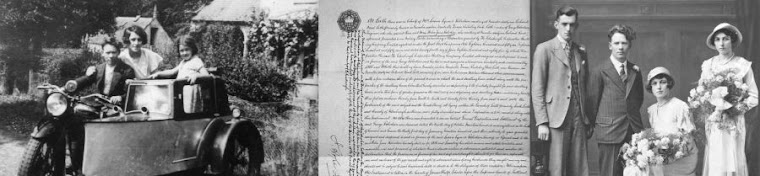
I seem to be concentrating on my mother's side of the family just now (the paternal line is stuck in a rut just now - awaiting adequate time and enthusiasm to start it up again!), so today I have a photo of my mother's parents on their wedding day to post (I use it in the website banner - so it might look familiar!).

Wedding 1934

My grandparents, Malcolm and Mary, are in the centre, and are accompanied by the witnesses to their wedding, John Miller and Rachel Macdonald.  They look so very elegant, I only wish that the wedding dress still remained in the family (although I imagine my grandmother would have been slimmer than me at that age, so I don't think I could have recycled it for my own wedding!)

The couple married on 29th June 1934 at St Cuthbert's Buildings, Corbiehill Road, Davidsons Mains, Edinburgh.  Their marriage certificate gives this as Malcolm's address and Mary lived at the place she worked as a domestic servant, 35 Inverleith Terrace, Edinburgh.  Malcolm was 34 and was a railway clerk, and Mary was 28.

Malcolm's parents were Alexander Macdonald (a retired railway plate layer) and Christina MacCrimmon.  Mary's parents were Donald Macdonald (a Church of Scotland missionary) and Isabella Macdonald.  The two witnesses also recorded their addresses on the marriage certificate: John was at 12 Clarence Street, Edinburgh, and Rachel was at the Southern General hospital, Glasgow (nursing was big in our family).


Conon Bridge picture

I also have this lovely photo of my grandparents on their honeymoon - they didn't go far, only a bit further up north in Scotland, but they did have this super photograph taken of them (with a young female relation of Malcolm's) up near to Conon Bridge (if anyone recognises the house, I would love to know!).

Thursday, 26 April 2012

Those Places Thursday - Peinchorran, Skye

While rooting through some of our own old family albums at the weekend I found a number of great shots of my great-grandparents' house on the Isle of Skye.  They (Donald and Isabella Macdonald) had moved there from the island of Harris just after the end of WW2 and my mother and aunt went often to visit them at their home at Peinchorran.  It was fairly remote and involved quite a journey to get there!  

You can get an idea of the location, spelled 'Piennachorian', on the 1832 map of the island [hint: find the island of Raasay first, then look across from the very bottom of Raasay to the opposite shore on the 'mainland' of Skye]


The picture above shows my mum 'being decorative' while her father Malcolm and uncle Donald look slightly more industrious - this must have been not long after my great-grandparents moved there, probably around 1946 (and yes, both men are smoking while they work!)  It was a fairly typical house of its period with the sloping upstairs ceilings that will be so familiar to any who have stayed in a house of this type.


This is probably one of my favourite old family photographs - it shows the house at Peinchorran and the typical contents of the ground outside it - I think that it's shots like this that can help to give a snapshot of 'real life' and 'real living' - milk pails, garden tools, and I think there's a butter churn in there somewhere too.  The two men coming around the corner are my mother's uncle, Angus Macdonald, and a man named Peter Nicolson - my mother remembers often watching for them coming home: they would return from the salmon fishing over the hill that you can see in the background, and would be watched for so that the family would know when to put the tea (dinner!) on. [if you look closely, the man on the left is carrying a bottle - my mother swears that it would be a bottle of milk that he was bringing home, but I like to think it might have been something a bit more fortifying for the walk home!]

Finding these two photos in a box really brought to life some of my ancestors and the place that they lived...and it also gave me some new questions to ask my mother about her own childhood and her memories of her family.  So, if you have any old photos at home, why not get them out and have a 'chin-wag' with someone who knows some of the people in them: you might get some new ancestor stories that you have never heard before...

Wednesday, 18 April 2012

Wordless Wednesday (My grandfather - at work and relaxing!)

At work: Malcolm Macdonald, at Peinchorran, Skye, c.1950...

...and relaxing: Malcolm Macdonald, at Edinburgh, c.1960

Saturday, 31 March 2012

Surname Saturday - My MacCrimmon Ancestors

I do not get a lot of time to spend on my own family history these days (it's like the old saying 'the cobbler's children go unshod' - well, my own ancestors too often remain unfound as I am so busy looking for other people's!)

But one of the lines of my family that does go back a way is that leading back to Iain Dubh MacCrimmon.  He is my great-great-great-grandfather and lived from c.1730 to 1822: not a bad lifespan really - I'll be quite happy if I make it that far!

He was twice married (some say 3 times, but I have not found much supporting evidence myself for this yet) and had a huge number of children - there must be an enormous number of descendants out there who are related to him.  

some of these children are said to be:

with his first wife 
(whose forename I cannot seem to track down, but she was a MacAskill):

DONALD MACCRIMMON
PADRUIG MOR MACCRIMMON
MALCOLM MACCRIMMON 
ELIZABETH MACCRIMMON 
JANET MACCRIMMON
FLORA MACCRIMMON 
MARION MACCRIMMON
CATHERINE MACCRIMMON  

with his wife, Ann Campbell, who he is said to have married in 1790 
(she is said to be of the line of the Campbells of Barbreck):

DUNCAN MACCRIMMON
PETER MACCRIMMON (my ancestor)
JOHN MACCRIMMON
EUPHEMIA MACCRIMMON
DONALD OG MACCRIMMON

(apologies to any that I have missed!  There is detailed information about these and other MacCrimmon lines at http://www.geocities.com/mccrimmon.geo/ which is a site that is really worth visiting).  

"Mac Cruimin". A plate illustrated by R. R. McIan, from James Logan's The Clans of the Scottish Highlands.
There are great legends about the history of these MacCrimmons, which I must admit I love, but which are not exactly easily verifiable!  One of the most famous legends is that the family originated in what is now Italy and that the founder of the family was from Cremona.  His name was supposedly Guiseppe Bruno.  His son Petrus Bruno was supposedly born at Cremona in the late 1400s and came to Ulster.  He took the name Cremon (after the place that he came from) and on his marriage in Ireland to a daughter of the famous piping family of MacKinnon he further altered his surname to MacCrimmon to bring it nearer to that of his wife.  This is great stuff, but not that easy to verify - so I'll probably not be booking a research trip to Italy any time soon! 

It seems at least possible that the name might also come from an attempt to render an old Norse name (possibly Hroðmundr) into Gaelic by adding the 'Mac' (son of) prefix to a variation of the Norse name, but I still love the Italian story...

My ancestor, Iain Dubh was a talented piper and a staunchly religious man.  Shortly before his death he wrote a pamphlet on 'The Failure of Christianity' which was said to have greatly annoyed the local clergy - the pamphlet is said to be buried with him.  I like having an outspoken ancestor - whether I agree with his principles or not!

Iain Dubh is sometimes said to be the very last of the hereditary MacCrimmon pipers.  The MacCrimmons had filled this roll to the MacLeods of Dunvegan, Skye, since at least the time of my 5x great-grandfather Patrick Og MacCrimmon (and possibly earlier).  Much of the information on the early lines of the family was published as A History of the Clan Mac Crimmon by GCB Poulter in 1938 and many of the early 'origin myths' of the family are found in this work (now available online at the MacCrimmon Family Registry).

There are tantalising references to MacCrimmons in earlier records: a 'Patrik Mcquhirryman, piper', mentioned in the Register of the Privy Council, vol.5 (1592–99) may be another ancestor (although he appears in Perthshire, the piping connection still seems promising).  There is also a bond of manrent dating from November 29, 1574 between Colin Campbell of Glenorchy and 'John Tailzoure Makchrwmen in the Kirktoun of Balquhidder and Malccolme pyper Mackchrwmen in Craigroy' - another piper: it was the 'family trade'...

Iain Dubh would have taught at the once famous Borreraig Piping College, of which nothing now remains, but a memorial cairn stands at Borreraig - it was built in 1933 after donations being gathered from around the world - a fitting tribute to a fine family.

  © Copyright Richard Dorrell and licensed for reuse under this Creative Commons Licence

My own work on the MacCrimmon family is far from over - it is a project to which I return at regular intervals and I am always happy to find new family members or discover new facts about any descendants.  I suppose that a lot of people have a 'favourite line' in their ancestry...and these MacCrimmons might just be mine...

Tuesday, 20 March 2012

Tombstone Tuesday - Alexander Cowie at Fordyce

Today's grave is situated in the beautiful grounds of the old churchyard at Fordyce, Banffshire.  Fordyce village is a lovely place to visit and the remains of the kirk are certainly worth looking in at if you are ever in the area.  There is some great information on the history of the Kirk and the village at the Fordyce Community website.


The gravestone was erected by James Cowie, weaver, for his father Alexander Cowie who died 27th June 1779 aged 64 years.  It is a beautifully simple headstone and really caught my eye.


Alexander's residence is given as 'Murerock' which must be 'Muirake' in the south of Fordyce parish - there is a site record about the house there on the RCAHMS website.


Tuesday, 6 March 2012

Kirk Session Records: more than just illegitimate children...

If you have ever heard of the Scottish Kirk Session records, then you may have first been drawn to them due to their research potential for finding out about the fathers of illegitimate babies born in the 19th century or earlier.  However, there is much more to the Kirk Session records than this...

First, however, a little bit of background about what they are and where they can be found.  Kirk Session minutes (recordings of the proceedings of the Session) can be found for a large number of parishes across Scotland for both the established Church of Scotland as well as dissenting Presbyterian churches (there are also records of other non-Presbyterian churches, but these really deserve a whole blog post of their own).

The Kirk Session comprised the minister and elders of the parish, and it was concerned with (in addition to the business of the parish) the morals of the parishioners.  This is the reason that Kirk Session records are so useful for finding out more about the parentage of illegitimate children - the Session would often interrogate any unwed mothers and put strong pressure on them to name the father of their baby.  Sometimes the couple would have to do penance for their sin of 'fornication' and other times you will find the whole circumstances of the case detailed over a number of pages of the Kirk Session records.

So how would you find out more about an illegitimate child?  Firstly, you need to know the relevant parish in which to look - often this is the parish where the mother usually resided, although you may find that the case moves to another parish once proceedings have started: if the session found that another parish was really responsible for the case, then the proceedings would sometimes move to that parish.  But, what you want to do is find out where the baby may have been born and/or where the mother usually lived.  

Next you need to locate the relevant parish records.  Although many Kirk Session records are held locally, there are digital images of the majority of the pre-1901 minutes at the National Records of Scotland (formerly National Archives of Scotland) in Edinburgh.  This means that you can view most of the early records for the established churches (and some of the dissenting churches) in Edinburgh for no charge (all you need is a reader's ticket - check the NRS website for details).  

As yet (March 2012) there is no widely available remote access to these, although some local archives also have access to digital images of these records (check with your local archive for details).  Once you have physically located the relevant minutes for the parish in question, then it is simply a case of identifying the correct volume which covers the dates in question and then searching through that volume for 'your' entry.  Not all illegitimate children appear in these records, but they are worth consulting if you have had no luck elsewhere.

The Kirk Session Minutes have much more to offer than simply telling you 'who's the daddy'!

In just a few examples, I can give a brief idea of the wealth of historical information that can be found in the Kirk Session records.  Most parishes have Minute Books where many discipline cases were recorded - this is not just illegitimacy cases, but drunkeness, breaching the sabbath, disputes between neighbours, even accusations of witchcraft!  If your ancestors lived in any parish for a length of time it is almost always worth browsing the minutes to see if your ancestors appear.

But, the specific example of the catalogue entries for the Kirk Session of Forgue [NRS ref. CH2/459] gives a flavour of the other types of information that you might find in the Kirk Session records:

Forgue Kirk Session records have Minutes dating from the 1630s, but they also contain:
Poor Fund Records from the 1700s and 1800s;
List of communicants from the 1830s and 1840s;
A census of the lands in the parish from the 1830s.


There are also many items of interest in many other collections of Kirk Session records.  The records of Glencorse Kirk Session [NRS ref. CH2/181] include:
Mortcloth records (relating to burials) from the early 1700s;
Testimonials or 'testificats'(a type of 'character reference' given when a person moved parish) dating from the late 1600s;
Communion rolls from the 1830s.


All of these may be of immense interest to those with family from these parishes - as any genealogist will know, information from the period before the mid-19th century is always to be treasured!

So, if you have a day to spare and are looking to expand your knowledge of your ancestors, then you could do far worse than to spend some time looking into the Kirk Session records of the parishes in which they lived.  

You never know what you might find...
Monday, 27 February 2012

Mappy Monday - Maps that I love...

I love using maps in my research, and although the National Library of Scotland is usually my first port of call for most Scottish maps, there are also some fantastic finds from other archives.

One of my favourite sets of maps is the 1769 estate plans of the Breadalbane estate on Loch Tay side.  These are superbly detailed and have useful accompanying information in the form of a survey book published by the Scottish History Society ["Survey of Lochtayside 1769" (Scottish History Society, 3rd series, vol. 27)].

Even if your ancestors did not hail from this area, the maps are lovely things to look at in and of themselves, and they are freely available to view online.  Click the links to view images of The North Side of the loch and The South Side of the loch at the Scotland's Places website.

Enjoy!

Saturday, 18 February 2012

Sympathy Saturday - Victims of the Scottish snow

As anyone who checks in on my blog now and then will know, I am a big fan of using newspapers for genealogy research.  Although it is more often the more well-to-do individuals who would place notices in the newspapers commemorating their life events, the early newspapers can be a real treasure trove of information about individuals from every walk of life.

This week's extracts come from two Scottish newspapers and have a sad seasonal theme - both detail the tragic cases of individuals caught outside in extreme weather in the Scottish winter.  Their stories are so sad, especially perhaps this extract telling the fate of Mr John Piggy and his son:


Caledonian Mercury, Thursday, January 16, 1800

From further north, we also have the sad case of William Mason from Glenbervie:


The Aberdeen Journal, Monday, January 13, 1800

As well as these named individuals, these extracts refer to a number of unknown souls whose lives were lost to the extreme weather.  We may never know who these people were, but in the era before statutory registration of deaths, the newspapers can sometimes give us a vital clue as to what happened to some of our ancestors.

Tuesday, 7 February 2012

Births, Marriages and Deaths - Today in the Glasgow Herald of 1851

Today's blog post is simply a list of the births, marriages and deaths recorded in the online archive of the Glasgow Herald newspaper, this day in 1851.

It is worth remembering that newspapers are a valuable source for genealogy and many are now available online - either freely over the internet (like this edition of the Herald) or via some subscription services (some local libraries and historical societies may subscribe - so do check before you take out a subscription yourself).

Glasgow Herald, 7 Feb 1851, pg.5
Births:
A daughter to Mrs Robert Robin
A son to the wife of C T Dunlop, esq.
A son to Mrs William R Findlay
A daughter to Mrs R Drummond
A son to Mrs James Hood
A daughter to Mrs George F Coulson
A daughter to Mrs William Wright
A son to Mrs R Forsyth
A daughter to Mrs James Allan

Marriages:
Mr A Forrester, merchant, Leith, to Mary Paton, daughter of John Paton esq., of Kilncraigs
Mr William Henry Alexander, Glasgow, to Jane Bryce, daughter of John Bryce esq., portioner, Calton
Alan Ker, esq., Greenock, to Julia Emily Easton, daughter of John Easton esq., MD, of Courance Hill, Dumfriesshire

Deaths:
Mr William Nicolson
Alexa McCallum
Catherine Loutet or Maclean
Elizabeth Howie
Jane Auchterlonie
George Gordon Semple, esq.
Mr James McGhie, sen.
Mr John Barrie
Captain Robert Kerr

Saturday, 28 January 2012

The George Washington Wilson and Co. Photographic Collection

While browsing for photographs of Scottish cities in days gone by, I came upon the George Washington Wilson and co. photographic collection which the University of Aberdeen have made available online.

This remarkable collection showcases the work of Wilson and his company.  The photographs include images of places across Scotland and the UK as well as from Australia, Africa, and European countries.  Wilson was named photographer royal  in 1860 and had an immensely successful career.

The fruits of his work as shared on this website are a great resource for anyone interested in family or local history as they give us glimpses of life in a variety of locations at various points in the 19th century.  Of particular note are the stunning images of Fingal's Cave and the beautiful images captured in Africa.

Image: m_bartosch / FreeDigitalPhotos.net
You can visit the website and search the images by place or keyword.  There are also a number of images that are yet to be identified, and if anyone recognises them, then I am sure that the archives staff at the University of Aberdeen would love to know.

Enjoy this great collection.

Tuesday, 24 January 2012

Tombstone Tuesday - George Aikman, surgeon, 1857


This mournful lady was spotted whilst I was walking through the Dean Cemetery last week.  She has been devotedly watching over the grave of George Aikman, surgeon, from East Linton, Prestonkirk, for over 150 years and I thought that such a vigil deserved mention!

George Aikman died on the 29th January 1857 aged 45 and left a widow, Jane Brown Smith, who survived her husband and lived for another 37 years.

George Aikman's death notice in the Scotsman of the 31st January (pg.3) gives few other details, but George appears in the 1841 census at Prestonkirk along with his wife, Jane (both aged 30).  They appear to have married the previous year at Prestonkirk.

In 1851 the couple are still at Prestonkirk (with no children but two servants).  George is named as a licentiate Royal College of Surgeons, Edinburgh.

It doesn't appear that they had any children before George's death in 1857, so I do not imagine that they have any direct descendants today, but if they link into your tree at some point then I hope that these images will prove interesting.


Wednesday, 18 January 2012

(Nearly) Wordless Wednesday - Fosters from Muirkirk, Kirkbean and Stewarton, c. 1911


Members of my family, c.1910-11: Robert Foster and Maggie Jane Kirk along with their children - Maggie Jane Foster (b.1900), Henry Kirk Foster (b.1902), Mary Agnes Foster (b.1905), Robert John Foster (b.1908), and twins William Alexander Foster and Jessie Edgar Foster (b.1909)

Thursday, 12 January 2012

Tenants in Meal Vennel, Perth, 1773 - P&K Council Archives

Perth and Kinross Council Archives are one of the many archives that have showcased some images from their fascinating collections on Flickr.  I often enjoy just browsing through the photo-streams of the various different archives and thought that I would point out any interesting/unusual/useful records which I come across on my travels.

Today I'm highlighting one record in particular, a census of Perth dating from 1773.  P&K District Archives have published a return dealing with properties in Meal Vennel on Flickr (document reference: GB252/B59/24/1/40).  

A database of the returns from this census is available through the ancestry.com website and you can view the original images too if you are a subscriber.

But, if you haven't used these records before then the image of the Meal Vennel return on Flickr will give you an idea of the type of information in the census.  Are any of these people your ancestors?

William Graham, aleseller
William Bryson, mason
William Sharp, doctor
Alexr McIntyre, taylor
John McDonald, labourer
William Reid, labourer
Kathrine Duff, widow
Elizabeth Stewart, widow
Jannet Robertson
Cathrine McDougall
Christan Robertson
James Gibson, weaver


Thursday, 10 November 2011

Thankful Thursday - the Macdonald brothers in WWI

An act of remembrance...

Image: dan / FreeDigitalPhotos.net

Today's post is a personal one in honour of three of my great uncles who made the ultimate sacrifice for their country and lost their lives long before I ever had the chance to know them.  


These were three of the five sons of my great-grandmother and great-grandfather, Christina MacCrimmon and Alexander Macdonald.  Thinking of them losing three sons in such quick succession is almost too much to bear.  


To John, Alexander and Duncan - and the countless others who have given their lives over the years - we send our heartfelt gratitude for your sacrifice.
 

In Memory of
Corporal JOHN MACDONALD

1292, "A" Coy., 2nd Bn., Argyll and Sutherland Highlanders
who died age 25
on 24 April 1917
Son of Alexander and Christina Macdonald, of Corbie Hill Rd., Davidson's Mains, Midlothian.
Remembered with honour
ARRAS MEMORIAL
Commemorated in perpetuity by
the Commonwealth War Graves Commission

In Memory of
Serjeant ALEXANDER MACDONALD

S/17540, 8th Bn., Black Watch (Royal Highlanders)
who died age 23
on 19 July 1918
Son of Alexander and Christina Macdonald, of Store Buildings, Davidson's Mains, Midlothian.
Remembered with honour
PLOEGSTEERT MEMORIAL
Commemorated in perpetuity by
the Commonwealth War Graves Commission

In Memory of
Private DUNCAN MACCRIMMON MACDONALD

203403, 1st/5th Bn., Highland Light Infantry
who died age 21
on 24 August 1918
Son of Alexander MacDonald and Christina MacCrimmon MacDonald, of Davidsons Mains, Edinburgh.
Remembered with honour
BAC-DU-SUD BRITISH CEMETERY, BAILLEULVAL
Commemorated in perpetuity by
the Commonwealth War Graves Commission

Friday, 4 November 2011

Major new project set up to study everyday life in Dumfries and Galloway

The European Ethnological Research Centre [EERC] has set up a brand new project aimed at gathering and publishing information about everyday life through the ages in Dumfries and Galloway.

This ambitious study, which is believed to be the first of its kind in the UK, aims to produce substantial publications in a variety of formats. It seeks to bring together research carried out by Dumfries and Galloway's inhabitants, academics and others sharing interests in such topics. 

The organisers say that they hope to publish the results in a variety of outputs, such as additions to their popular Flashback series and in multi-authored books, as well as having online resources associated with the study.  

They will also be holding public events, such as concerts and exhibitions, in which the results of research will be disseminated. 

Image: nuttakit / FreeDigitalPhotos.net
Perhaps one of the the most interesting aspects of this study is that it is designed to be participative, with the people of Dumfries and Galloway being involved in the process.

They have set up a project blog, where you can find out more and where interested parties can contact the organisers.

It looks to be an interesting attempt to trace the history and culture of people in a particular place through the experiences of the ordinary folk who live and have lived there. 


Saturday, 15 October 2011

Scottish Life Archive

Looking around on the internet the other day, I came across the page for the Scottish Life Archive, which seems to have had a bit of a facelift since the last time I visited the website.

The archive has been around since the 1950s and aims to collect, record and preserve documentary and illustrative evidence of Scotland's material culture and social history.  

They have built up a fascinating collection of material that could be useful for anyone researching aspects of Scottish local or family history and you can get a taste of what they have by visiting their website, and you can view images of some of their photographic collections on flickr.

Viewing the collections is by appointment only (see their website for contact details), as well as holding photographic and film material the Scottish Life Archive is home to a unique collection of manuscripts, letters, diaries, books, leaflets, oral recordings, maps, plans, trade catalogues, paper ephemera and an extensive newspaper cuttings collection.

If you're searching for details about a particular person, place or theme, then it might well be worth a visit.


Tuesday, 20 September 2011

Scots Abroad: Emigration Stories from Scottish Emigrants

A 'shout-out' today for another great online resource that is interesting, informative and FREE!

The National Library of Scotland [NLS] have a great digital resource available at http://digital.nls.uk/emigration/index.html which links you to transcripts of letters and journals, and audio versions of these, along with background information and really great visual resources - drawings, photos, maps and pamphlets and much more.

This is a fascinating glimpse into the huge range of records that the NLS have and gives a real glimpse into the lives of people who left these shores to create new lives.

There is a lot of very detailed information in these pages and it is well worth 'bookmarking' to return to again and again.  The website also links into the NLS Scots Abroad database which gives details of material relating to the lives of Scots and their experiences overseas.

Image: Idea go / FreeDigitalPhotos.net

Saturday, 10 September 2011

St Kilda and Mingulay School Log Books Online

The last school log books for the islands of St Kilda and Mingulay have gone online as part of a joint effort between the National Records of Scotland (NRS) and the Tasglann nan Eilean Siar (Hebridean Archives).

These books were written by the teachers and give a fascinating insight into life on these Scottish islands.  The Mingulay log book dates from 1875 to 1910 and the St Kilda log book covers the years from 1901-1930 - that takes us right up to the date when the island was evacuated.

They are interesting documents to browse through for a real glimpse of the way people lived on these remote islands.  Well worth a look...


Image: Felixco, Inc. / FreeDigitalPhotos.net

Thursday, 4 August 2011

Scottish Archive looking for your old family movies...

The Scottish Screen Archive has a remarkable collection of film and video documenting the social and cultural history of Scotland over the past 100 years and more.

Their films cover much of 20th-century Scottish social, cultural and industrial history as well as giving rare glimpses into the lives of ordinary Scots across the generations.

Now they are looking for help with their latest project: Specifically they are asking for donations of films shot between 1970 and 2010 including those from:

Video workshops, Community groups, Action groups, Cine / video clubs, Promotional films for local industries / charities / tourism, Sport and leisure, Footage depicting significant changes in local communities, Special local community events – e.g. gala days, millennium celebrations and more...

An additional project is seeking evidence of children using film technology and they are looking for material from those
  • who made their own movies as a child
  • who were part of a group that ran video workshops for children
  • who participated as a child in movie making during the 1970s-2000.
Contributing to the archival collections could mean helping to create an invaluable resource for future generations who may look back in 50 or 100 years or more and ask what our lives were like now.  So if you have some old cine-film lying around the house, now might be the time to dig it out.

Find out more at the Scottish Screen Archive website.


Image: dan / FreeDigitalPhotos.net